Explore ICL surgery in Sydney when laser eye surgery is not suitable

ICL surgery places a thin corrective lens inside the eye, while keeping your natural lens in place

Explore ICL surgery in Sydney when laser eye surgery is not suitable

ICL surgery places a thin corrective lens inside the eye, while keeping your natural lens in place

With Implantable Collamer Lenses, you can reduce reliance on glasses or contact lenses

Get clear answers on who ICLs may suit, how it works, what to expect, and the benefits and risks to consider

ICL may be considered for adults who:

  • Between 21 and 60 years old, generally under 45 years of age.
  • Nearsighted with mild to severe myopia (-0.5D to -20D).
  • Farsighted with mild to severe hyperopia (+0.5D to +10D).
  • Have astigmatism (0.5D to 6D). In this setting, select patients can be fitted with a toric EVO ICL option.
  • Have a stable prescription (no change of more than 0.5D over a year).
  • Looking for a procedure that doesn’t exacerbate dry eye syndrome.
  • May be a good option for people who are not candidates for laser vision correction (e.g. thin corneas, risk of ectasia).

Implantable collamer lenses (ICLs) or phakic intraocular lens insertion, is a surgical procedure for correcting refractive error. Unlike laser refractive surgery, which reshapes the cornea, a synthetic lens is placed inside the eye, whilst leaving the natural lens intact. This is different to cataract surgery, where the natural lens is removed and replaced by a prosthetic implant. This procedure can correct a wide range of refractive errors including severe nearsightedness, farsightedness and astigmatism and offers a permanent solution for those seeking long-term vision improvement.

At Eagle Eye Laser we use the EVO Implantable Collamer Lens (ICL) (STAAR Surgical).

Advantages

  • Corrects high myopia and hyperopia that laser refractive surgery cannot treat
  • Quick and minimally invasive
  • Sharp and clear vision
  • Does not induce dry eye

Disadvantages

  • Night vision can be impacted with peripheral and/or central haloes as well as starbursts
  • Does not reduce or eliminate the need for future cataract surgery
  • For patients with symptoms of presbyopia, near vision glasses are needed for precise activities

While phakic ICL surgery is generally safe and well-tolerated, like any surgical procedure, it carries some risks and potential complications. It is important to be aware of these risks before undergoing the surgery.

Some potential risks and complications include:

  • Infection: Although extremely rare, there is a small risk of developing an infection after phakic ICL surgery. We will prescribe antibiotic eye drops to minimise this risk, and it is crucial to use them as directed.
  • Raised intraocular pressure
  • Over or undercorrection
  • Loss of best corrected vision
  • Second operation (removal of lens, repositioning of lens)
  • Inflammation
  • Glaucoma: In some cases, phakic ICL surgery can increase the risk of developing glaucoma, a condition characterised by increased pressure in the eye. Regular follow-up appointments can help monitor and manage this risk.
  • Cataract: While phakic ICL surgery preserves the natural lens, there is a small (<1%) chance of developing early cataract as a result of the surgery.
  • Corneal Endothelial Cell Loss: Phakic ICL surgery may cause a slight loss of corneal endothelial cells, which are responsible for maintaining the clarity of the cornea. In most cases, this loss is minimal and does not cause any significant visual impairment.
  • Halos and Glare: Some patients may experience central or peripheral halos or glare around lights, especially at night, after phakic ICL surgery. These visual disturbances usually improve over time as the eyes adjust.

Alternatives depend on your eyes and goals. Some people continue with glasses or contact lenses. Others may be suitable for laser vision correction options such as LASIK or PRK-type procedures. For some age groups or prescriptions, lens-based options like refractive lens exchange may be discussed. The right choice depends on eye health, corneal measurements, lifestyle needs, and comfort with risk and recovery. A full assessment is the best way to compare options safely.

  • Step 1 is a detailed assessment to confirm suitability and measure your eye anatomy for lens sizing and power.
  • Step 2 is a planning and consent visit where your surgeon explains options, benefits, limits, and risks, and answers your questions.
  • Step 3 is the procedure day, performed in a controlled clinical environment.
  • Step 4 is early recovery, including eye drops and guidance on activity and healing.
  • Step 5 is follow-up visits to monitor eye pressure, lens position, healing, and vision quality over time. Ongoing checks help ensure long-term eye health.
Many suitable people choose ICL because it can deliver clear vision for everyday life and significantly reduce reliance on glasses or contact lenses. After treatment, a large number of patients find they can do most day-to-day activities without glasses.

After your assessment, your surgeon will explain what is realistic for your eyes, based on precise measurements, so you have clear expectations from the start.

As healing progresses, vision often becomes more stable, and follow-up visits are built in to support you and confirm everything is settling well, including eye pressure and lens position.

3 simple steps to life with less dependence on glasses or contacts

Laser eye surgery can feel like a big decision. We make the process clear, supportive, and easy to follow

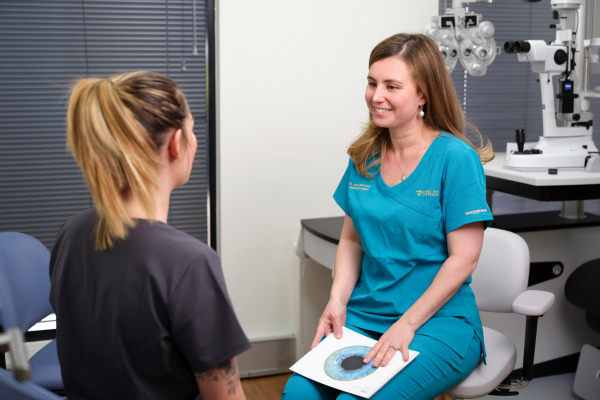
Step 1: Get in touch

Laser eye surgery isn’t for everyone. The first step is to get a clear answer on whether laser vision correction can help you or not. Book a free appointment online or call us

Step 2: We'll meet

At your appointment, we will discuss your lifestyle and answer your questions. If you are suitable, we will explain your options so you can make an informed choice.

Step 3: Enjoy more freedom

After treatment, many patients notice everyday tasks can feel easier with less reliance on glasses or contact lenses. Things like exercise, travel, work, and getting ready in the morning may feel simpler.

Find out if laser vision correction could reduce your need for glasses or contacts

Book a free appointment and our team will answer your questions, and explain which vision correction options may suit your eyes and lifestyle

Get your questions answered about laser eye treatment in Sydney

Explore simple, expert-led blogs that explain your options, what to expect, and the everyday benefits people look for, so you can feel clear and confident about your next step

Could laser eye surgery be right for you?

Take our free 2-minute self-test to explore which laser vision correction options may suit your prescription, eyes, and daily life

Hi, I’m Dr. Erica Darian-Smith

I’m a FRANZCO ophthalmic surgeon focused on refractive surgery. I trained in Sydney at Prince of Wales Hospital, then completed a two-year corneal and refractive fellowship in Toronto, Canada. I also hold a Graduate Diploma in Cataract and Refractive Surgery and a Master of Medicine in Ophthalmic Sciences from the University of Sydney, and I lecture there as a Clinical Lecturer. I am a Fellow of the World College of Refractive Surgery and Vision Sciences and have a subspecialty interest in treating presbyopia.

I take time to listen, explain options clearly, and guide you through each step so you can make informed choices with confidence and calm. I am passionate about getting you your best visual outcomes.

Owner
FRANZCO, FWCRS, MMed, MBBS

Hi, I’m Dr. Mitch Lee

I’m a FRANZCO trained ophthalmic surgeon. My work covers refractive surgery, cataract surgery, complex anterior segment and lens surgery, and conditions of the retina and vitreous. I completed medical training at the University of Sydney and Royal Prince Alfred Hospital, then completed ophthalmology training in the Prince of Wales Hospital network. I am trained in refractive surgery and have completed the Forefront Refractive Surgery Course run by the highly respected London Vision Clinic. I have further fellowship level training in complex anterior segment surgery and vitreoretinal surgery.

In addition to my work with Eagle Eye Surgeons, I am the Head of Department for Ophthalmology at Nepean Hospital and have led the expansion of publicly funded eye surgery in the Nepean Blue Mountains Local Health District.

I focus on clear explanations, careful planning, and follow-up that keeps you supported at every stage, always.

Owner
FRANZCO, MMed(Critical Care), MBBS(Hons), BSc