PRK eye surgery in Sydney may help reduce the daily hassle of glasses and contacts

Discover how this flap-free laser treatment reshapes the surface of the cornea to help correct vision for suitable patients

PRK eye surgery in Sydney may help reduce the daily hassle of glasses and contacts

Discover how this flap-free laser treatment reshapes the surface of the cornea to help correct vision for suitable patients

With PRK, suitable patients may reduce their dependence on glasses and contact lenses

Learn how this established laser eye procedure works, including the benefits, risks, and whether it may be right for you

PRK may suit adults with a stable glasses prescription who want to reduce their need for glasses or contact lenses. It can treat short sight, long sight, and astigmatism, which means the eye has an uneven curve.

PRK may be a suitable option for individuals who are not candidates for LASIK due to thinner corneas or other corneal irregularities, or sometimes for patients who have had previous laser eye surgery.

PRK is often considered for people whose work, sport, or lifestyle makes a flap-free procedure more suitable. Your eyes also need to be healthy.

(Photorefractive Keratectomy) is an older technique that predates LASIK but is still widely used today, especially when LASIK is not an option.

With PRK, the thin outer layer of the cornea, known as the epithelium, is removed to allow direct reshaping of the underlying cornea with the excimer laser.

The epithelium then regenerates naturally over time.

Advantages

  • Suitable for thinner corneas: PRK can be a better choice for individuals with thinner corneas, as it does not require the creation of a corneal flap like LASIK.
  • No flap-related complications: Since PRK does not involve creating a flap, there is no risk of flap-related complications such as dislocation or epithelial ingrowth.
  • Stable long-term results1https://pubmed.ncbi.nlm.nih.gov/31830293/: PRK has been shown to provide stable long-term visual outcomes, making it a reliable choice for certain individuals.

Disadvantages

  • Longer recovery time: Compared to LASIK, PRK has a longer recovery period, as the epithelium needs to regenerate after it is removed during the procedure. There is the small risk of epithelium related complications such as delayed healing or rarely, infection.
  • Increased discomfort: Some individuals may experience more discomfort during the initial healing phase after PRK compared to LASIK. We will apply a bandage contact lens to the eye following the procedure that our surgeons will remove for you at the 1 week follow-up. You will be required to see the surgeon at day 1, day 3, day 5 and day 7 post procedure.
  • Potential haze: Although rare, a small percentage of PRK patients may develop corneal haze, which can temporarily or in some cases permanently affect vision clarity. The risk of this is reduced by application of a specialised chemical called Mitomycin C during the laser surgery procedure.

Like any eye procedure, PRK has risks and possible side effects. These can include discomfort in the first few days, blurred vision, dry eye, glare, halos, light sensitivity, and slower visual recovery than other laser treatments.

Some people may also have under-correction or over-correction, which means the final result may not be exactly as planned.

Infection and inflammation are uncommon, but they can occur and need prompt treatment.

Corneal haze can also develop during healing in some cases.

No procedure can guarantee perfect vision or complete freedom from glasses. A full consultation helps explain the risks and likely outcomes for your eyes.

If PRK is not the best fit, there are other vision correction options. These may include LASIK, SMILE Pro, implantable contact lenses, lens replacement, or continuing with glasses or contact lenses.

The right option depends on your prescription, corneal thickness, eye health, age, and visual needs. Some people are better suited to one treatment than another.

A full assessment can help identify the safest and most appropriate choice for your eyes and lifestyle.

  1. On the day, numbing eye drops are used to keep you comfortable.
  2. The thin outer layer of the cornea is gently removed.
  3. Then the laser reshapes the cornea to correct the focusing error.
  4. A soft bandage contact lens is placed on the eye to protect it while it heals.
  5. The same process is then done for the other eye.
  6. After treatment, you go home with eye drops, aftercare advice, and follow-up visits arranged to monitor healing.
PRK is designed to help reduce your reliance on glasses and contact lenses by improving how light focuses in the eye. For many people, that can mean daily life feels easier, with fewer moments of reaching for eyewear. Many patients notice meaningful changes over the first few weeks, with vision continuing to settle over time.

3 simple steps to life with less dependence on glasses or contacts

Laser eye surgery can feel like a big decision. We make the process clear, supportive, and easy to follow

Step 1: Get in touch

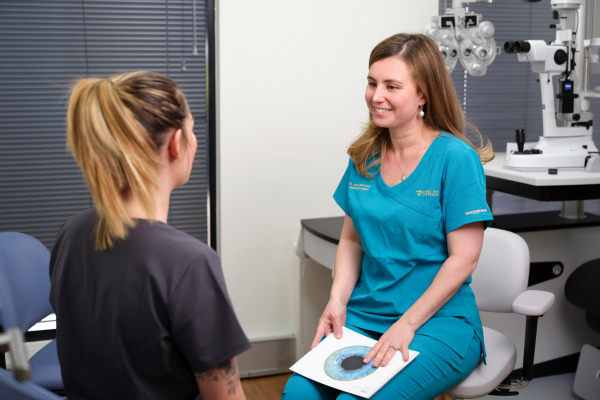
Laser eye surgery isn’t for everyone. The first step is to get a clear answer on whether laser vision correction can help you or not. Book a free appointment online or call us

Step 2: We'll meet

At your appointment, we will discuss your lifestyle and answer your questions. If you are suitable, we will explain your options so you can make an informed choice.

Step 3: Enjoy more freedom

After treatment, many patients notice everyday tasks can feel easier with less reliance on glasses or contact lenses. Things like exercise, travel, work, and getting ready in the morning may feel simpler.

Find out if laser vision correction could reduce your need for glasses or contacts

Book a free appointment and our team will answer your questions, and explain which vision correction options may suit your eyes and lifestyle

Get your questions answered about laser eye treatment in Sydney

Explore simple, expert-led blogs that explain your options, what to expect, and the everyday benefits people look for, so you can feel clear and confident about your next step

Could laser eye surgery be right for you?

Take our free 2-minute self-test to explore which laser vision correction options may suit your prescription, eyes, and daily life

Hi, I’m Dr. Erica Darian-Smith

I’m a FRANZCO ophthalmic surgeon focused on refractive surgery. I trained in Sydney at Prince of Wales Hospital, then completed a two-year corneal and refractive fellowship in Toronto, Canada. I also hold a Graduate Diploma in Cataract and Refractive Surgery and a Master of Medicine in Ophthalmic Sciences from the University of Sydney, and I lecture there as a Clinical Lecturer. I am a Fellow of the World College of Refractive Surgery and Vision Sciences and have a subspecialty interest in treating presbyopia.

I take time to listen, explain options clearly, and guide you through each step so you can make informed choices with confidence and calm. I am passionate about getting you your best visual outcomes.

Owner
FRANZCO, FWCRS, MMed, MBBS

Hi, I’m Dr. Mitch Lee

I’m a FRANZCO trained ophthalmic surgeon. My work covers refractive surgery, cataract surgery, complex anterior segment and lens surgery, and conditions of the retina and vitreous. I completed medical training at the University of Sydney and Royal Prince Alfred Hospital, then completed ophthalmology training in the Prince of Wales Hospital network. I am trained in refractive surgery and have completed the Forefront Refractive Surgery Course run by the highly respected London Vision Clinic. I have further fellowship level training in complex anterior segment surgery and vitreoretinal surgery.

In addition to my work with Eagle Eye Surgeons, I am the Head of Department for Ophthalmology at Nepean Hospital and have led the expansion of publicly funded eye surgery in the Nepean Blue Mountains Local Health District.

I focus on clear explanations, careful planning, and follow-up that keeps you supported at every stage, always.

Owner
FRANZCO, MMed(Critical Care), MBBS(Hons), BSc